

Nature’s Fury: Understanding the Mumbai–Pune Expressway Missing Link
Where extreme terrain, relentless monsoons and bold engineering ambition collide, the Mumbai–Pune Expressway Missing Link emerges as a landmark of India’s infrastructure prowess. At its core, Navayuga Engineering’s world-class tunnels and Afcons Infrastructure’s iconic cable-stayed bridge redefine what is possible in the Sahyadris. Rising majestically above the valley, the bridge stands as a formidable symbol of strength, precision and resilience — showcasing engineering excellence against one of the country’s most unforgiving terrains.

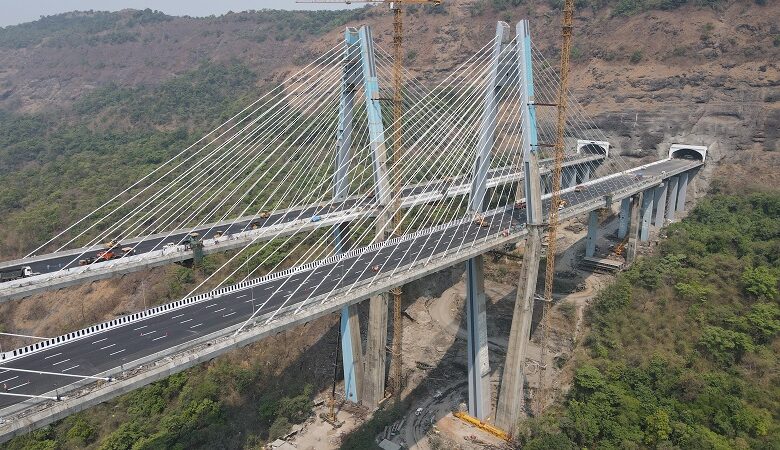
A story of engineering excellence, courage and a structure built to stand tall against nature’s fury.
The recent incident of boulder rolling on to the Mumbai–Pune Expressway Missing Link tunnel portal has sparked questions about construction quality. However, experts emphasize that the event must be seen in the context of the extraordinary natural forces at play in the Sahyadri region’s extreme weather conditions, where rainfall intensity often reaches unprecedented levels.
The Missing Link, featuring the world’s widest road tunnels and India’s tallest cable-stayed bridge, remains structurally sound and is expected to serve commuters safely and reliably for many years to come.
The Missing Link area is among the heaviest rainfall zones in India. Monsoon downpours here are not only frequent but also ferocious, with sudden cloudbursts capable of overwhelming natural slopes and engineered structures alike. In such terrain, even the most advanced safety measures can be tested by nature’s unpredictability. Fog, landslides, and cascading sheets of water during peak monsoon months make this one of the most challenging environments for infrastructure anywhere in the country.
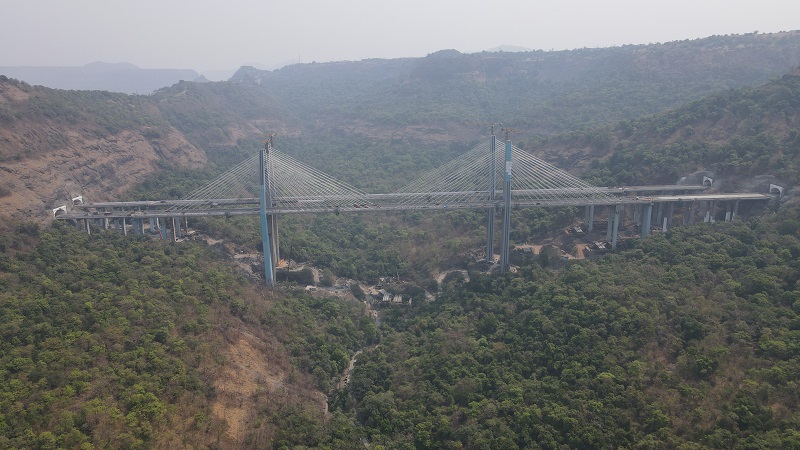
C&A Magazine looks at the Mumbai–Pune Expressway Missing Link not merely as a transportation corridor, but as a compelling story of engineering resilience. In a landscape where mountains, monsoons and geology continually test the limits of construction, the project demonstrates how technology, expertise and determination can transform formidable natural barriers into landmark infrastructure. At the centre of this achievement stands Navayuga Engineering Company Ltd executed the construction of the world’s widest road tunnels, while Afcons Infrastructure Ltd stands out as its most striking engineering achievement. Rising high above the Sahyadris, the bridge is not merely a vital link across the valley — it is a powerful demonstration of Afcons’ engineering expertise, precision and ability to deliver complex structures in some of the country’s most challenging environments. With its towering pylons, 240 stay cables and 650-metre span, the bridge stands as a symbol of strength, resilience and construction excellence, showcasing how bold engineering can overcome some of nature’s most formidable challenges.
On July 6, 2026, a devastating combination of a boulder fall and landslide struck near Tunnel-2 on the Pune-to-Mumbai corridor of the Missing Link, after relentless rainfall dumped more than 625 mm within 24 hours. The intense downpour caused the collapse of a protective slab and retaining wall at the tunnel’s entrance, unleashing nearly 100 tonnes of mud and rock onto the carriageway. A deep-rooted boulder, previously assessed as non-threatening during construction, dislodged from the unstable slopes and became the critical trigger for the incident. While the tunnel’s main structure remained intact, the event underscored the vulnerability of the newly built stretch to extreme weather and geological risks.
This vulnerability is not unique to India. As highlighted by the European Data Journalism Network, Thessaly in Greece suffered the most significant transport network damage in Europe over the past two years, with 1,590 km of roads and nearly 149 km of rail infrastructure destroyed by floods. These global examples underline a simple truth: when nature unleashes its fury, even the strongest infrastructure can be temporarily compromised. During the 2021 European floods, at least seven railway bridges along Germany’s Ahr Valley Railway were destroyed.
Despite the formidable challenges of the Sahyadris, the Mumbai–Pune Expressway Missing Link Project stands tall as a symbol of India’s engineering prowess.
At its heart are twin tunnels officially recognized by Guinness World Records as the widest underground road tunnels globally, which are designed to accommodate eight lanes of traffic. With a record width of 22.33 metres, they are designed to carry multiple lanes of traffic across two massive tubes — one stretching 8.92 km and the other measuring 1.67 km and 1.75 km respectively. Together, these tunnels redefine underground road infrastructure in India, ensuring smoother and safer passage through the rugged Sahyadri ranges.
Adding to this feat is country’s tallest road cable-stayed bridge, soaring 136 metres above the valley floor with pylons rising to 184 metres. Supported by 240 cables and stretching 650 metres in length, the bridge bypasses the treacherous Khandala Ghat, trimming the expressway’s distance by over six kilometres and cutting travel time by more than 25 minutes. Building such a structure in one of India’s most rainfall-intensive zones is proof of resilience and innovation.
AFCONS: ENGINEERING A BRIDGE THAT STANDS TALL
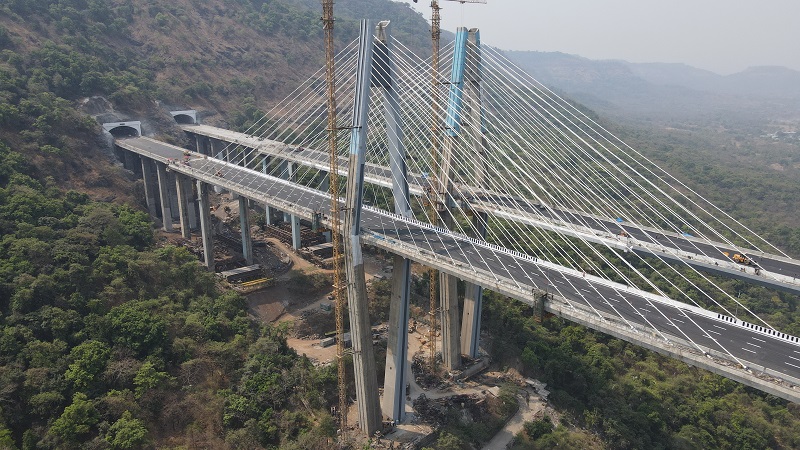
Delivered by Afcons Infrastructure Ltd, the iconic cable-stayed bridge is one of the defining engineering achievements of the Mumbai–Pune Expressway Missing Link. Rising majestically above the Sahyadri valley, the structure represents strength, precision and resilience in an environment where terrain and weather constantly challenge construction.
With its 184-metre-high pylons, 240 cables and 650-metre span, the bridge is a striking demonstration of Afcons’ ability to execute complex infrastructure in some of the country’s most demanding conditions. More than its impressive dimensions, the structure reflects meticulous engineering, careful planning and the ability to deliver a critical infrastructure link in a highly challenging mountain environment.
The bridge stands as a powerful symbol of engineering confidence — built amid steep ridges, unpredictable winds, intense monsoon rainfall and restricted access. Today, its towering presence over the Sahyadris represents not only a major connectivity achievement but also Afcons Infrastructure’s engineering capability and commitment to delivering landmark infrastructure that is built to endure.
Navayuga Engineering Company Ltd executed the construction of the world’s widest road tunnels, while Afcons Infrastructure Ltd delivered India’s tallest cable-stayed bridge, together shaping the landmark Mumbai–Pune Expressway Missing Link.
“The bridge, located in the Sahyadri region, presented extreme challenges: narrow ridges left little room for heavy machinery, wind speeds could shift from a gentle breeze to violent blasts of 100 km/h within minutes, and monsoon rains turned cliffs into cascading sheets of water, halting work instantly. Fog often rolled in without warning, reducing visibility to just a few metres,” said Ranjan Kumar Mishra, Project Director, Afcons.
These extraordinary conditions underline the magnitude of Afcons’ achievement. Building a bridge of this scale in such an unpredictable environment demanded engineering precision, disciplined execution, advanced construction expertise and an unwavering focus on safety and quality.
Ultimately, the incident is a reminder that infrastructure projects across the world—from the Alps to the Himalayas—remain vulnerable to unpredictable natural phenomena. Rather than questioning the quality of work, it is important to recognize the scale of environmental challenges and the courage it takes to build in such conditions. The Mumbai–Pune Expressway Missing Link Project, crowned by India’s tallest cable-stayed bridge, remains a symbol of progress and perseverance in the face of nature’s fury.
Key Features
- Guinness World Record tunnels: Twin underground road tunnels, officially recognized as the widest globally, with a width of 22.33 metres.
- India’s tallest cable-stayed bridge: 650-metre viaduct rising 136 metres above the valley, with soaring 184-metre pylons supported by 240 cables.
- Afcons Infrastructure: Delivered India’s tallest road cable-stayed bridge, overcoming challenging terrain, extreme weather and demanding construction conditions.
- Expressway widening: Expansion from six to eight lanes over 5.86 km, easing congestion and improving safety.
- Approach and slip roads: More than 10 km of new connecting roads to streamline entry and exit.
- Travel efficiency: Distance reduced by over six kilometres, cutting journey time between Mumbai and Pune by more than 25 minutes.

