
Afcons honoured with CII Environmental Excellence Award
Afcons Infrastructure Limited has been recognised for its environmental practices on the Mumbai–Ahmedabad High Speed Rail Project (C-2 Package), winning the CII National Award for Environmental Best Practices 2026 in the Biodiversity Management category. The award acknowledges the company’s efforts to integrate resource efficiency and environmental responsibility into complex infrastructure execution, from recovering materials from concrete washout waste and reusing tunnelling muck to treating wastewater and maximising natural daylight at project facilities

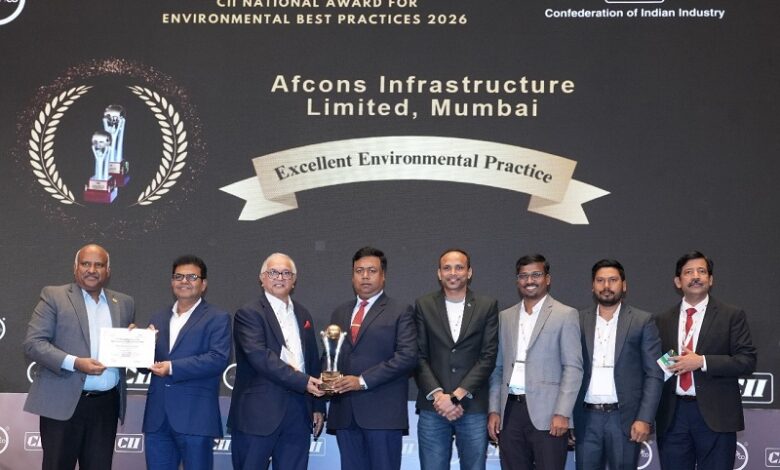
Afcons Infrastructure Limited has been honoured with the CII National Award for Environmental Best Practices 2026 in the category of Biodiversity Management for its work on the Mumbai-Ahmedabad High Speed Rail Project (C-2 Package). The award recognizes Afcons’ commitment to integrating industry-leading environmental stewardship into large-scale infrastructure development while maintaining operational excellence and sustainable project delivery.
Commenting on the achievement, Mr. Giridhar Rajagopalan, Deputy Managing Director, Afcons Infrastructure Limited, said, “At Afcons, sustainability is integral to how we execute projects. Our approach focuses on minimizing environmental impacts through rigorous environmental management, responsible resource utilization, and sustainable construction practices. This recognition reflects Afcons’ innovative approach to sustainable infrastructure development and environmental responsibility.”
The award was received by Mr. Mihir Mishra, Vice President – CPE, and Mr. Sumon Paul, Asst. General Manager – HSE, along with the Afcons team, at a ceremony held in Chennai on October 9, 2026.
The project adopted circular economy practices by recycling concrete washout waste to recover sand, aggregates and water, reusing tunnelling muck in segment casting, treating tunnel wastewater before discharge, and maximizing natural daylight through roof skylights, significantly reducing resource consumption, waste generation, energy use and environmental impact.

